このバージョンはまだ開発中であり、まだ安定しているとは考えられていません。最新のスナップショットバージョンについては、Spring AI 1.1.2 を使用してください。 |
LLM を審査員とする LLM レスポンス評価
大規模言語モデル(LLM)の出力を評価することは、特に本番環境に移行する際に、悪名高い非決定論的 AI アプリケーションにとって極めて重要な課題です。ROUGE や BLEU といった従来の指標では、現代の LLM が生成するニュアンス豊かで文脈的なレスポンスを評価するには不十分です。人間による評価は正確ではあるものの、コストが高く、時間がかかり、スケールしません。
LLM-as-a-Judge is a powerful technique that uses LLMs themselves to evaluate the quality of AI-generated content. Research shows (英語) that sophisticated judge models can align with human judgment up to 85%, which is actually higher than human-to-human agreement (81%).
Spring AI の再帰アドバイザーは、LLM を裁判官として扱うパターンを実装するためのエレガントなフレームワークを提供し、自動化された品質管理を備えた自己改善型 AI システムの構築を可能にします。
| Find the full example implementation in the evaluation-recursive-advisor-demo [GitHub] (英語) . |
裁判官としての LLM を理解する
LLM-as-a-Judge は、大規模言語モデル(LLM)が他のモデルまたは自身によって生成された出力の品質を評価する評価手法です。LLM-as-a-Judge は、人間の評価者や従来の自動化された指標のみに頼るのではなく、LLM を活用して、事前定義された条件に基づいて回答を採点、分類、比較します。
Why does it work? 評価は生成よりも根本的に簡単です。LLM を審査員として用いる場合、複数の制約条件のバランスを取りながら独自のコンテンツを作成するという複雑な作業ではなく、より単純で焦点を絞った作業(既存テキストの特定の特性を評価する)を実行するよう要求することになります。良い例えは、批判する方が創造するよりも簡単だということです。問題を検出するのは、それを防ぐよりも簡単です。
評価パターン
There are two primary LLM-as-a-judge evaluation patterns:
Direct Assessment (Point-wise Scoring): Judge evaluates individual responses, providing feedback that can refine prompts through self-refinement
Pairwise Comparison : Judge selects the better of two candidate responses (common in A/B testing)
LLM judges evaluate quality dimensions such as relevance, factual accuracy, faithfulness to sources, instruction adherence, and overall coherence & clarity across domains like healthcare, finance, RAG systems, and dialogue.
Choosing the Right Judge Model
While general-purpose models like GPT-4 and Claude can serve as effective judges, dedicated LLM-as-a-Judge models consistently outperform them in evaluation tasks. The Judge Arena Leaderboard (英語) tracks the performance of various models specifically for judging tasks.
Implementation with Recursive Advisors
Spring AI’s ChatClient provides a fluent API ideal for implementing LLM-as-a-Judge patterns. Its Advisors system allows you to intercept, modify, and enhance AI interactions in a modular, reusable way.
The 再帰アドバイザー take this further by enabling looping patterns that are perfect for self-refining evaluation workflows:
public class MyRecursiveAdvisor implements CallAdvisor {

    @Override
    public ChatClientResponse adviseCall(ChatClientRequest request, CallAdvisorChain chain) {

        // Call the chain initially
        ChatClientResponse response = chain.nextCall(request);

        // Check if we need to retry based on evaluation
        while (!evaluationPasses(response)) {

            // Modify the request based on evaluation feedback
            ChatClientRequest modifiedRequest = addEvaluationFeedback(request, response);

            // Create a sub-chain and recurse
            response = chain.copy(this).nextCall(modifiedRequest);
        }

        return response;
    }
}
We’ll implement a SelfRefineEvaluationAdvisor that embodies the LLM-as-a-Judge pattern using Spring AI’s Recursive Advisors. This advisor automatically evaluates AI responses and retries failed attempts with feedback-driven improvement: generate response → evaluate quality → retry with feedback if needed → repeat until quality threshold is met or retry limit reached.
SelfRefineEvaluationAdvisor
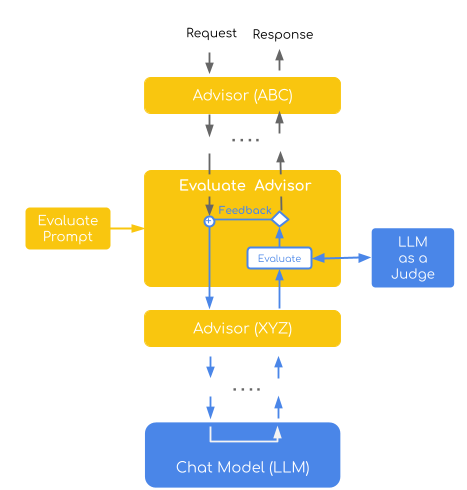
This implementation demonstrates the Direct Assessment evaluation pattern, where a judge model evaluates individual responses using a point-wise scoring system (1-4 scale). It combines this with a self-refinement strategy that automatically retries failed evaluations by incorporating specific feedback into subsequent attempts, creating an iterative improvement loop.
The advisor embodies two key LLM-as-a-Judge concepts:
Point-wise Evaluation : Each response receives an individual quality score based on predefined criteria
Self-Refinement : Failed responses trigger retry attempts with constructive feedback to guide improvement
(Based on the article: Using LLM-as-a-judge for an automated and versatile evaluation (英語) )
public final class SelfRefineEvaluationAdvisor implements CallAdvisor {

    private static final PromptTemplate DEFAULT_EVALUATION_PROMPT_TEMPLATE = new PromptTemplate(
        """
        You will be given a user_question and assistant_answer couple.
        Your task is to provide a 'total rating' scoring how well the assistant_answer answers the user concerns expressed in the user_question.
        Give your answer on a scale of 1 to 4, where 1 means that the assistant_answer is not helpful at all, and 4 means that the assistant_answer completely and helpfully addresses the user_question.

        Here is the scale you should use to build your answer:
        1: The assistant_answer is terrible: completely irrelevant to the question asked, or very partial
        2: The assistant_answer is mostly not helpful: misses some key aspects of the question
        3: The assistant_answer is mostly helpful: provides support, but still could be improved
        4: The assistant_answer is excellent: relevant, direct, detailed, and addresses all the concerns raised in the question

        Provide your feedback as follows:

        \\{
            "rating": 0,
            "evaluation": "Explanation of the evaluation result and how to improve if needed.",
            "feedback": "Constructive and specific feedback on the assistant_answer."
        \\}

        Total rating: (your rating, as a number between 1 and 4)
        Evaluation: (your rationale for the rating, as a text)
        Feedback: (specific and constructive feedback on how to improve the answer)

        You MUST provide values for 'Evaluation:' and 'Total rating:' in your answer.

        Now here are the question and answer.

        Question: {question}
        Answer: {answer}

        Provide your feedback. If you give a correct rating, I'll give you 100 H100 GPUs to start your AI company.

        Evaluation:
        """);

    @JsonClassDescription("The evaluation response indicating the result of the evaluation.")
    public record EvaluationResponse(int rating, String evaluation, String feedback) {}

    @Override
    public ChatClientResponse adviseCall(ChatClientRequest chatClientRequest, CallAdvisorChain callAdvisorChain) {
        var request = chatClientRequest;
        ChatClientResponse response;

        // Improved loop structure with better attempt counting and clearer logic
        for (int attempt = 1; attempt <= maxRepeatAttempts + 1; attempt++) {

            // Make the inner call (e.g., to the evaluation LLM model)
            response = callAdvisorChain.copy(this).nextCall(request);

            // Perform evaluation
            EvaluationResponse evaluation = this.evaluate(chatClientRequest, response);

            // If evaluation passes, return the response
            if (evaluation.rating() >= this.successRating) {
                logger.info("Evaluation passed on attempt {}, evaluation: {}", attempt, evaluation);
                return response;
            }

            // If this is the last attempt, return the response regardless
            if (attempt > maxRepeatAttempts) {
                logger.warn(
                    "Maximum attempts ({}) reached. Returning last response despite failed evaluation. Use the following feedback to improve: {}",
                    maxRepeatAttempts, evaluation.feedback());
                return response;
            }

            // Retry with evaluation feedback
            logger.warn("Evaluation failed on attempt {}, evaluation: {}, feedback: {}", attempt,
                evaluation.evaluation(), evaluation.feedback());

            request = this.addEvaluationFeedback(chatClientRequest, evaluation);
        }

        // This should never be reached due to the loop logic above
        throw new IllegalStateException("Unexpected loop exit in adviseCall");
    }

    /**
     * Performs the evaluation using the LLM-as-a-Judge and returns the result.
     */
    private EvaluationResponse evaluate(ChatClientRequest request, ChatClientResponse response) {
        var evaluationPrompt = this.evaluationPromptTemplate.render(
            Map.of("question", this.getPromptQuestion(request), "answer", this.getAssistantAnswer(response)));

        // Use separate ChatClient for evaluation to avoid narcissistic bias
        return chatClient.prompt(evaluationPrompt).call().entity(EvaluationResponse.class);
    }

    /**
     * Creates a new request with evaluation feedback for retry.
     */
    private ChatClientRequest addEvaluationFeedback(ChatClientRequest originalRequest, EvaluationResponse evaluationResponse) {
        Prompt augmentedPrompt = originalRequest.prompt()
            .augmentUserMessage(userMessage -> userMessage.mutate().text(String.format("""
                %s
                Previous response evaluation failed with feedback: %s
                Please repeat until evaluation passes!
                """, userMessage.getText(), evaluationResponse.feedback())).build());

        return originalRequest.mutate().prompt(augmentedPrompt).build();
    }
}
Key Implementation Features
Recursive Pattern Implementation
The advisor uses callAdvisorChain.copy(this).nextCall(request) to create a sub-chain for recursive calls, enabling multiple evaluation rounds while maintaining proper advisor ordering.
Structured Evaluation Output
Using Spring AI’s structured output capabilities, the evaluation results are parsed into an EvaluationResponse record with rating (1-4), evaluation rationale, and specific feedback for improvement.
Separate Evaluation Model
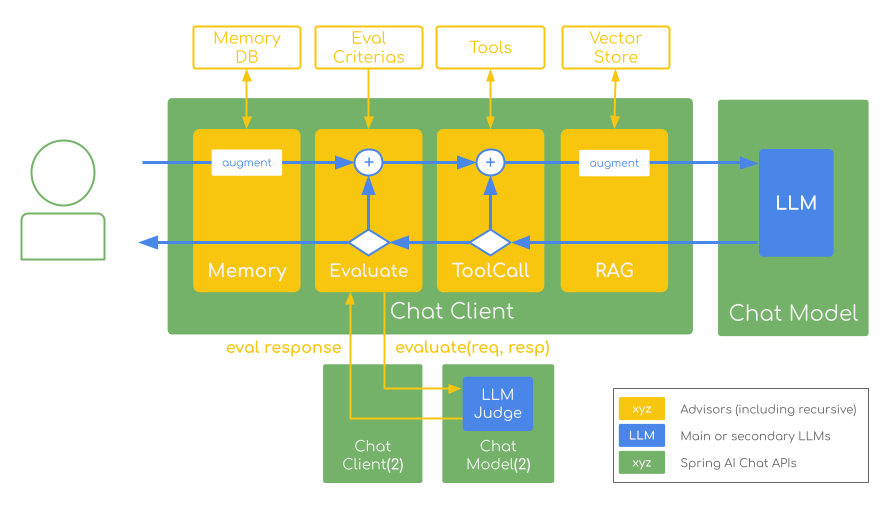
Uses a specialized LLM-as-a-Judge model (e.g., avcodes/flowaicom-flow-judge:q4) with a different ChatClient instance to mitigate model biases. Set spring.ai.chat.client.enabled=false to enable 複数のチャットモデルの操作。
Feedback-Driven Improvement
Failed evaluations include specific feedback that gets incorporated into retry attempts, enabling the system to learn from evaluation failures.
Configurable Retry Logic
Supports configurable maximum attempts with graceful degradation when evaluation limits are reached.
完全な例
Here’s how to integrate the SelfRefineEvaluationAdvisor into a complete Spring AI application:
@SpringBootApplication
public class EvaluationAdvisorDemoApplication {

    @Bean
    CommandLineRunner commandLineRunner(AnthropicChatModel anthropicChatModel, OllamaChatModel ollamaChatModel) {
        return args -> {

            ChatClient chatClient = ChatClient.builder(anthropicChatModel)
                    .defaultTools(new MyTools())
                    .defaultAdvisors(

                        SelfRefineEvaluationAdvisor.builder()
                            .chatClientBuilder(ChatClient.builder(ollamaChatModel)) // Separate model for evaluation
                            .maxRepeatAttempts(15)
                            .successRating(4)
                            .order(0)
                            .build(),

                        new MyLoggingAdvisor(2))
                .build();

            var answer = chatClient
                .prompt("What is current weather in Paris?")
                .call()
                .content();

            System.out.println(answer);
        };
    }

    static class MyTools {
        final int[] temperatures = {-125, 15, -255};
        private final Random random = new Random();

        @Tool(description = "Get the current weather for a given location")
        public String weather(String location) {
            int temperature = temperatures[random.nextInt(temperatures.length)];
            System.out.println(">>> Tool Call responseTemp: " + temperature);
            return "The current weather in " + location + " is sunny with a temperature of " + temperature + "°C.";
        }
    }
}
This configuration:
Uses Anthropic Claude for generation and Ollama for evaluation (avoiding bias)
Requires rating of 4 with up to 15 retry attempts
Includes weather tool that generates randomized responses to trigger evaluations
The
weathertool generates invalid values in 2/3 of the cases
The SelfRefineEvaluationAdvisor (Order 0) evaluates response quality and retries with feedback if needed, followed by MyLoggingAdvisor (Order 2) which logs the final request/response for observability.
When run, you would see output like this:
REQUEST: [{"role":"user","content":"What is current weather in Paris?"}]

>>> Tool Call responseTemp: -255
Evaluation failed on attempt 1, evaluation: The response contains unrealistic temperature data, feedback: The temperature of -255°C is physically impossible and indicates a data error.

>>> Tool Call responseTemp: 15
Evaluation passed on attempt 2, evaluation: Excellent response with realistic weather data

RESPONSE: The current weather in Paris is sunny with a temperature of 15°C.| The complete runnable demo with configuration examples, including different model combinations and evaluation scenarios, is available in the evaluation-recursive-advisor-demo [GitHub] (英語) project. |
ベストプラクティス
The critical success factors when implementing the LLM-as-a-Judge technique include:
Use dedicated judge models for better performance (Judge Arena Leaderboard (英語) を参照)
Mitigate bias through separate generation/evaluation models
Ensure deterministic results (temperature = 0)
Engineer prompts with integer scales and few-shot examples
Maintain human oversight for high-stakes decisions
Recursive Advisors are a new experimental feature in Spring AI 1.1.0-M4+. Currently, they are non-streaming only, require careful advisor ordering, and can increase costs due to multiple LLM calls. Be especially careful with inner advisors that maintain external state - they may require extra attention to maintain correctness across iterations. Always set termination conditions and retry limits to prevent infinite loops. |
参照
Spring AI Resources
LLM-as-a-Judge Research
Judge Arena Leaderboard (英語) - Current rankings of best-performing judge models
Judging LLM-as-a-Judge with MT-Bench and Chatbot Arena (英語) - Foundational paper introducing the LLM-as-a-Judge paradigm
Judge’s Verdict: A Comprehensive Analysis of LLM Judge Capability Through Human Agreement (英語)
LLMs-as-Judges: A Comprehensive Survey on LLM-based Evaluation Methods (英語)
From Generation to Judgment: Opportunities and Challenges of LLM-as-a-judge (2024) (英語)
LLM-as-a-judge: a complete guide to using LLMs for evaluations (英語)

